
Franklin County Court Records After a Jail Arrest
After an arrest in Franklin County, the custody side and the court side are handled by different offices. The Franklin County Sheriff's Office operates the Franklin County Jail and House of Correction at 160 Elm Street in Greenfield, and its records-access page says sheriff-held records concern committed offenders and jail custody. The same research points requesters to the arresting city or town police department for police reports and records checks, and to the court for court proceedings and possible charges. That split is important because Franklin County court records after a jail arrest are not the same thing as a jail booking sheet.
The typical path starts with an arrest by a local, state, or other law-enforcement agency. If the person is held locally, the person may be lodged at the Franklin County Jail and House of Correction for intake, property inventory, screening, and classification. The case then moves to arraignment or another first court event, where charges and release conditions are addressed. The Northwestern District Attorney's Office serves Franklin County, and the prosecutor's filed charges become the court record that should be checked for events, dispositions, and later changes. For custody status and booking detail, use jail inmate records. For booking photos and the lack of an official county mugshot gallery, use jail mugshots.
The Northwestern District Attorney contact page lists the Franklin County office in Greenfield and a public-records access officer for DA records. Prosecutor records are not a substitute for the court docket, but the DA office is the local charging agency for many criminal matters after a Franklin County arrest.
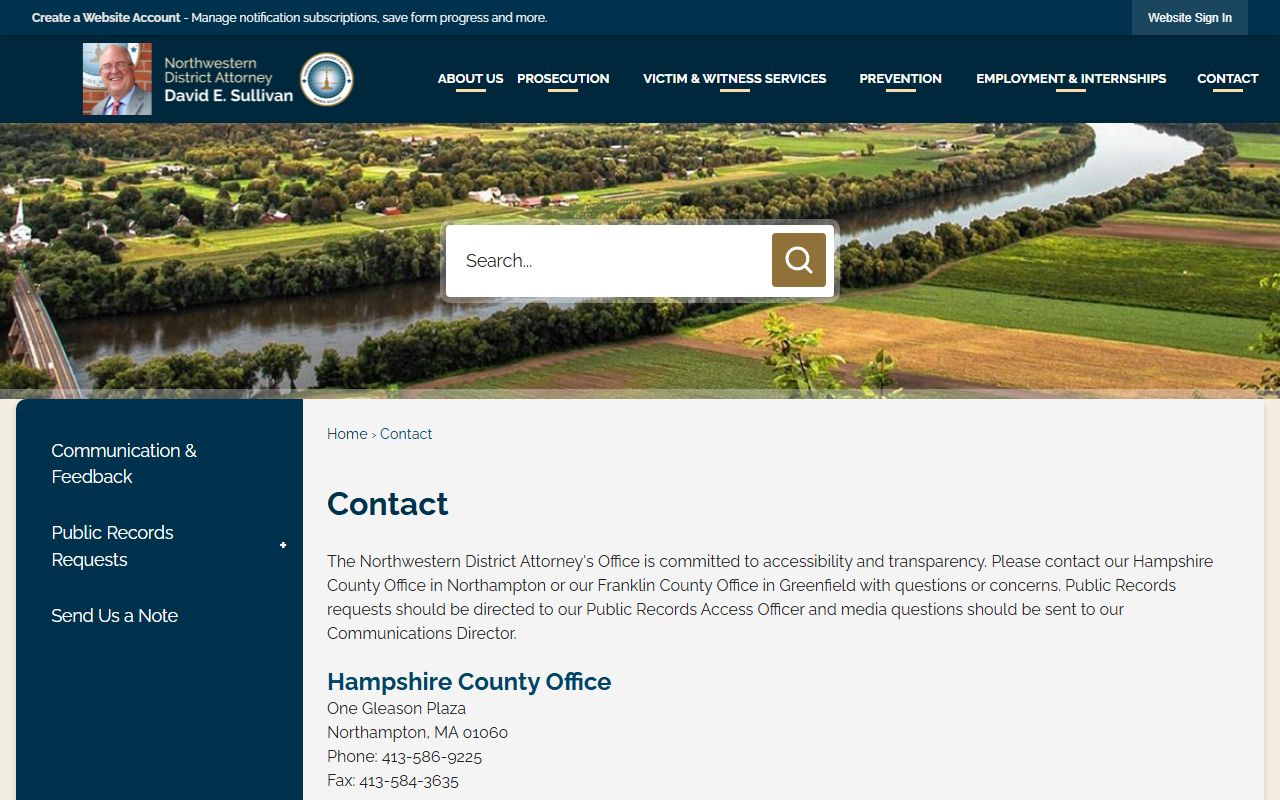
Use the DA contact information for prosecutor or DA public-records questions, then use the relevant court or MassCourts entry to confirm the filed charge status.
How to Find Franklin County Court Records After an Arrest
Massachusetts Trial Court Case Access, commonly called MassCourts, is the main public case-access portal for looking up court records after an arrest. The portal can show party, event, docket, case type, and disposition information, but it is not the official record of the court. Mass.gov also warns that most criminal cases are available online only by docket number. A name search may work for some case types, but a Franklin County criminal case often requires the docket number from court paperwork, counsel, a clerk's office, or a daily list.
- Open MassCourts Trial Court Case Access and choose the Trial Court department and division when the workflow requires it.
- Use the docket or case number if known. For Franklin County criminal matters, that number may be the most reliable search key.
- If the docket number is unknown, identify the likely court by arrest location, charge level, and paperwork, then contact the clerk with the person's full name, arrest date, and arresting agency.
- Open the case entry and read the charge list, docket events, court dates, attorney information where shown, and disposition or charge status where available.
The Mass.gov docket-search help page explains the court search process and reinforces the distinction between public online access and official court records. Daily lists and calendar information can change, and a clerk's office remains the best source for certified copies or official record questions.
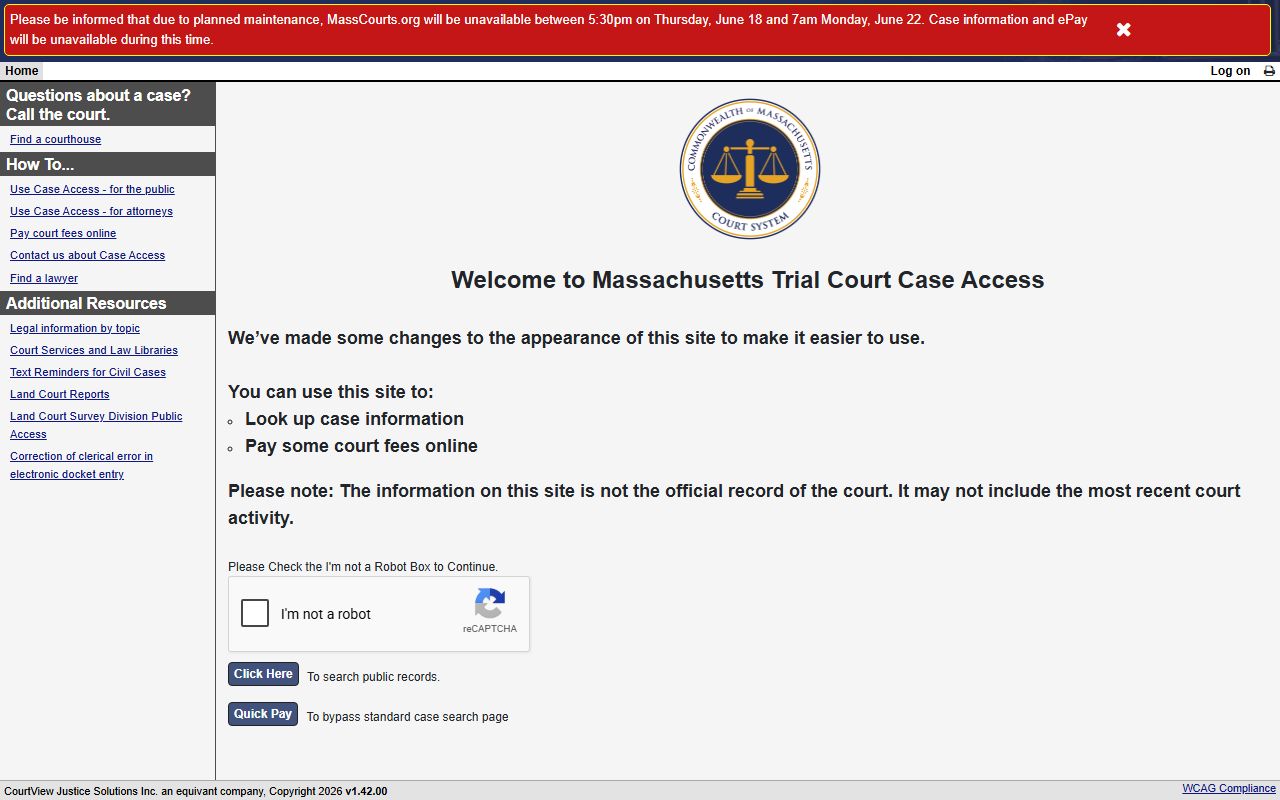
If the online search does not return a usable criminal case, the next step is the clerk's office for the likely Franklin County court division.
Local Courts for Court Records After a Franklin County Arrest
Franklin County criminal matters may be in District Court or Superior Court depending on the charge, case posture, and charging decision. Franklin County Superior Court is at 43 Hope Street in Greenfield and serves all cities and towns in Franklin County. The clerk's number in the research is 413-775-7400, and probation is listed at 413-773-7249. Greenfield District Court serves communities including Greenfield, Montague, Deerfield, Sunderland, Shelburne, Northfield, Whately, and several western and northern Franklin County towns. Orange District Court serves Athol, Orange, Erving, Leverett, New Salem, Shutesbury, Warwick, and Wendell.
When no docket number is available, the clerk's office for the likely division can help determine whether a case exists and how public access works. FCSO's records-access guidance is consistent with that route: the jail can address custody records, but court proceedings and possible charges must be obtained from the court. Police reports still belong with the arresting agency unless another office created or maintains the record being requested.
How Charges Get Filed After an Arrest: Complaint, Information, and Indictment
A Franklin County jail arrest may begin with allegations listed by police or reflected in booking paperwork, but the charge record matures when a prosecutor proceeds in court. District Court misdemeanor and many felony matters may begin by complaint. Serious felony matters may move in Superior Court through indictment. Massachusetts research for this county did not identify an "information" track as the primary local criminal filing route, so the table treats information as a prosecutor-filed charging document only in general terms and keeps the focus on complaint and indictment for Franklin County practice.
| Complaint | Information | Indictment | |
|---|---|---|---|
| Filed By | Usually initiated through District Court criminal process based on police/prosecutor allegations. | Filed by a prosecutor where a prosecutor-filed charging document is available. | Returned by a grand jury and prosecuted in Superior Court. |
| Common For | Misdemeanors and many felony matters that begin in District Court. | Jurisdiction-specific prosecutor filings, not the main Franklin detail found in research. | Serious felony matters and cases moved to Superior Court. |
| Record Impact | Opens a docket with charges, events, bail/release entries, and disposition fields where available. | Creates or continues the formal court charge record when used. | May replace or supersede earlier allegations and move the case to Superior Court. |
The charge shown at booking can differ from the charge ultimately filed in court. Prosecutors may amend, reduce, dismiss, or add charges as the case develops, and a grand jury indictment can change the court record after the first arrest event.
Charge Status and What It Means
Charge status is one of the most useful parts of court records after a jail arrest. It tells whether the accusation is still active, has been changed, or has reached a final outcome. A single Franklin County case may have multiple charges with different statuses, so each count should be read separately. One charge might be dismissed while another remains pending, is reduced, or ends in a conviction.
| Status | What It Means |
|---|---|
| Pending | The charge or case is still active and has not reached final disposition. |
| Amended / Reduced | The filed charge changed after the initial court entry, often because prosecutors or the court modified the charge level or wording. |
| Dismissed | The court or prosecution ended that charge without a conviction on that count. |
| Nolle Prosequi | The prosecutor declined to continue prosecuting that charge. |
| Disposition | The final outcome or status entry for the charge or case, where available in the record. |
| Conviction | A finding or admission of guilt. It is not the same as an arrest, booking charge, or pending accusation. |
Bail, Release, and Holds After an Arrest
Massachusetts uses recognizance, unsecured appearance bonds, cash bail, release conditions, dangerousness hearings, and bail revocation rules. M.G.L. c.276 Section 58 governs release on personal recognizance, unsecured appearance bond, and bail review. Section 58A governs dangerousness hearings, and Section 58B governs bail revocation and detention. A bail magistrate may review the defendant's record and decide whether release is allowed before a scheduled court date, while post-arraignment decisions are handled through the court process.
| Release or Hold Type | How It Works |
|---|---|
| Personal Recognizance | Release based on a promise to appear, without posting cash bail. |
| Unsecured Appearance Bond | A financial obligation may apply if the defendant fails to appear. |
| Cash Bail | Money is posted to secure appearance. Post-arraignment cash bail may be returned if required appearances are satisfied. |
| Conditions of Release | Nonfinancial terms may be imposed to manage appearance or safety concerns. |
| Dangerousness Detention | Under Section 58A, qualifying cases can result in detention without bail after a hearing. |
| Bail Revocation | Under Section 58B, release can be revoked when statutory conditions are met. |
Franklin County research did not locate a public FCSO bail counter, hours, or payment-method table. The practical route is to confirm the case status with the court or jail, ask whether the person is pre-arraignment or post-arraignment, and verify any court hold, dangerousness hearing, probation issue, warrant, or detainer. Massachusetts is not a typical commercial bail-bond marketplace. Bail Rule 24 recognizes a professional bondsman only under Superior Court registration and verification rules, so generic advice to call a bond company can be misleading.
Warrants That Lead to an Arrest or Block Release
No official Franklin County public active-warrant search and no statewide public active-warrant lookup were located in the research. Massachusetts warrant access is not built around a public roster. M.G.L. c.276 Section 23A governs the Warrant Management System, and WMS records are accessible through CJIS to law enforcement agencies and the Registry of Motor Vehicles. That makes WMS a law-enforcement and court infrastructure tool, not a public self-service search box.
Warrants also matter after bail is set. M.G.L. c.276 Section 29 requires a WMS check before release, discharge, or admission to bail in a criminal matter. A person may have bail set in one Franklin County case but remain in custody because of an outstanding warrant, fugitive hold, detainer, probation issue, dangerousness order, or bail revocation. To resolve a warrant, contact a criminal defense attorney, the issuing court clerk, or the court's probation or bail office. FCSO at 413-774-4014 is the local custody contact if the person has already been arrested and lodged at the jail.
Charges vs. Convictions in Court Records After an Arrest
An arrest is not a conviction. A charge is an accusation filed or continued in court, while a conviction requires a guilty plea, admission, verdict, or other conviction-level disposition. Court records after a Franklin County arrest should be read with that distinction in mind, especially when the jail booking allegation differs from the final court charge.
| Charge | Conviction | |
|---|---|---|
| Stage | Accusation or filed count in the criminal case. | Final guilt-based outcome by plea, admission, or verdict. |
| Proof Standard | Earlier stages can be based on probable cause or charging review. | Requires proof beyond a reasonable doubt or a valid plea/admission. |
| Record Meaning | Shows what was alleged or prosecuted. | Shows a final criminal outcome on that charge. |
| Practical Caution | May later be dismissed, amended, reduced, or not prosecuted. | May affect sentencing, probation, CORI, and collateral consequences. |
Sealed vs. Expunged Arrest and Court Records
Massachusetts provides separate procedures for sealing and expungement. Sealing generally limits public visibility of qualifying criminal records, while expungement is a stricter remedy that can remove or destroy a qualifying record so it is treated as if it did not exist for many purposes. Eligibility depends on the charge, disposition, waiting period, age, mistake or fraud issues, and other statutory factors. A dismissal does not automatically mean every related arrest, jail, police, CORI, and court record disappears from all systems.
| Sealed | Expunged | |
|---|---|---|
| Visibility | Generally hidden from ordinary public access after a qualifying order. | Removed or destroyed under strict eligibility rules. |
| Access | Some agencies or legally authorized users may retain limited access. | Access is more limited, but eligibility is narrower. |
| Best Route | Use the Mass.gov criminal-record sealing process and confirm what court or agency holds the record. | Use Mass.gov expungement eligibility guidance before assuming a case qualifies. |
CORI law, M.G.L. c.6 Section 172, controls dissemination of criminal offender record information. CORI is not the same thing as the public court docket, a police report, or a jail booking record, but it affects how criminal-history information may be released and logged.
Background Check Considerations
Court records after an arrest can be useful for checking a docket, but they should not be treated as a complete background check. A MassCourts entry may be limited, a criminal case may require a docket number, and the online portal is not the official record of the court. Employers, landlords, insurers, lenders, and screening companies must follow the Fair Credit Reporting Act, Massachusetts CORI rules, and any other applicable screening laws. Casual public-record lookup is different from a legally compliant consumer report.
Important: Franklin County Inmate Population is not a consumer reporting agency, and court or jail information may not be used for FCRA-regulated screening.
Restricted Court Records After an Arrest in Franklin County
Not every record connected to a Franklin County arrest is publicly available online. Juvenile matters, sealed records, expunged records, some dismissed matters, CORI-restricted information, active-investigation material, victim or witness information, and law-enforcement-only warrant details may be withheld or limited. Massachusetts Public Records Law, M.G.L. c.66 Section 10, starts from a broad public-records rule, but exemptions and separate confidentiality laws still apply. The Secretary of the Commonwealth's public-records guidance explains that Massachusetts records made or received by agencies are generally presumed public unless an exemption permits withholding.
For sheriff-held custody or booking records, Franklin County requests can be sent to records@fcso-ma.us or mailed or hand delivered to Franklin County Sheriff's Office, ATTN: Records/Capt. Jason Yuryan, 160 Elm Street, Greenfield, MA 01301. Telephone requests may be accepted at 413-774-4014 ext. 2191 at FCSO discretion. For police reports, use the arresting police department. For filed charges, case events, dispositions, certified copies, or court-record restrictions, use Franklin Superior Court, Greenfield District Court, Orange District Court, or MassCourts depending on the case.